In shortMosquito Bay's glowing water comes from one dinoflagellate, Pyrodinium bahamense var. bahamense, which Guinness World Records cited in 2006 at up to 700,000 per gallon. The cells flash blue-green only when the water around them is disturbed, so paddle strokes, a trailed hand and the wake of a hull do the lighting. As of 9 October 2026, readings were effectively zero.
700,000dinoflagellates per gallon
Class SADRNA water classification
Weeklycounts by the trust's biologist
1980National Natural Landmark
What makes Mosquito Bay glow
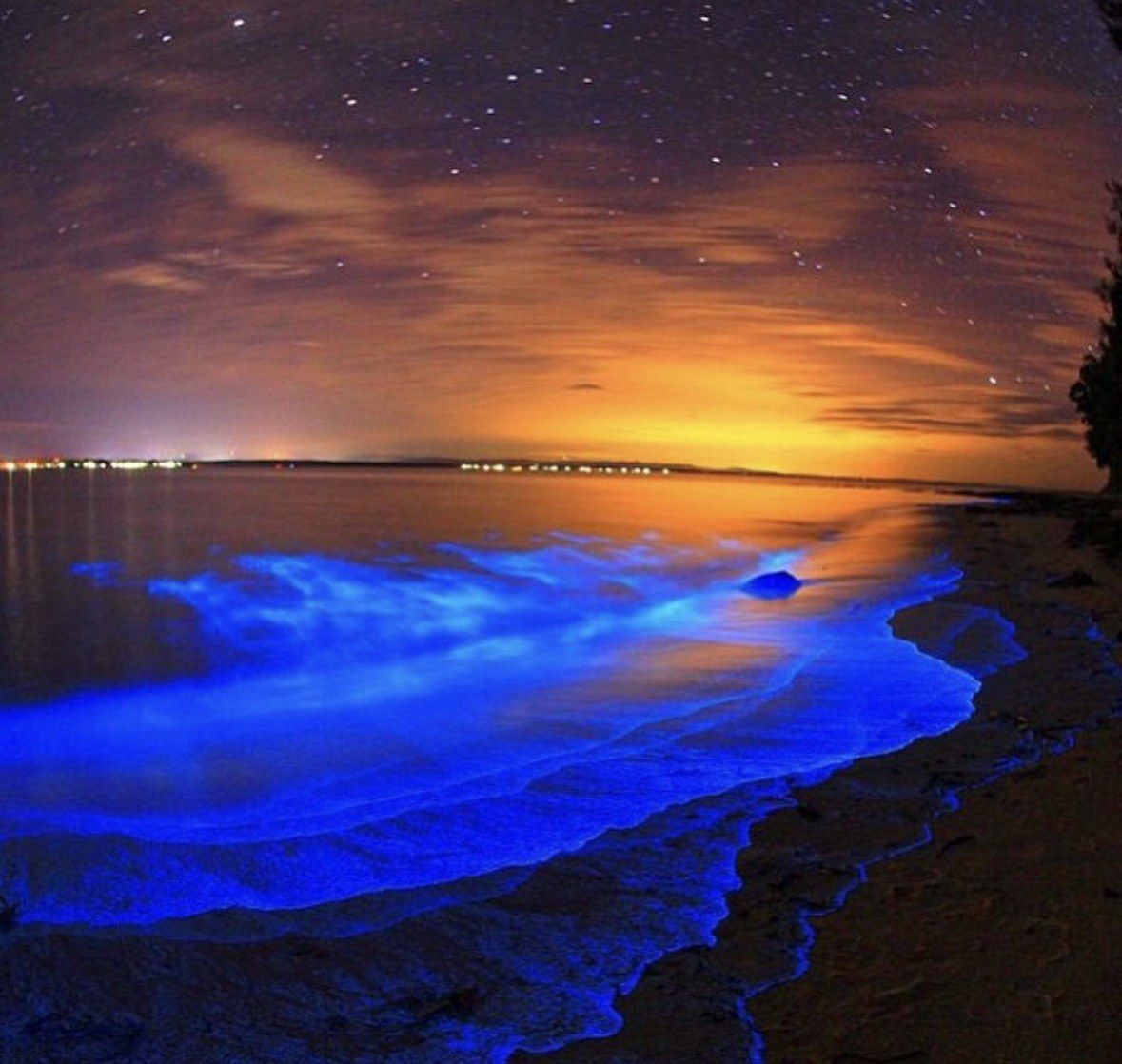
The light has a single author: Pyrodinium bahamense var. bahamense, a dinoflagellate. One cell, far too small to see, and a gallon of bay water can hold hundreds of thousands of them. The biologist at the co-managing trust counts this one species week by week, because the brightness you get on any given night is a direct function of how many cells are suspended in the water you paddle through.
Each cell carries a chemical reaction that fires when its outer membrane is deformed. Push the water and the cells in that patch light for a fraction of a second, then go dark. That is the whole mechanism, and it explains what most visitors get wrong: an untouched surface stays black, and light appears only where something has moved it.
Colour is consistently described as blue-green. It reads brightest at the edge of your vision, once your eyes have had twenty minutes away from phone screens and headlights.
Why they pile up in this particular lagoon
Dinoflagellates live in warm seawater all over the Caribbean. What is unusual at Puerto Mosquito is retention: a shallow lagoon ringed by mangroves, with one narrow opening to the sea. Water that comes in on the tide drains out slowly, so the population stays put instead of dispersing. Mangrove leaf litter feeds it from the edges.
The official record backs that up. Guinness World Records entered Mosquito Bay in 2006 as the brightest bioluminescent bay, on a figure of up to 700,000 dinoflagellates per gallon of water. Water quality belongs to the same equation: the EPA's phrase for the lagoon is the only pristine bioluminescent bay in Puerto Rico, and DRNA's Class SA listing, the top category for ecological and recreational value, is the regulatory shorthand for what the cells need. The National Natural Landmark citation that followed the 1980 proclamation calls it the best example of a bioluminescent bay in the United States.
The same geometry is the weak point. Almost every mangrove at the mouth died after Hurricane Maria, which costs the lagoon both the leaf litter feeding the cells and part of the rim that holds them in; the scientists who assessed the damage gave natural regrowth a span of 15 to 30 years.
Mosquito Bay glowing water seen from a kayak or a boat
Expect nothing at all for the first minute. You arrive in the dark, your eyes adjust, and the surface looks like any other black lagoon. Then the guide tells someone to stir it, and the water under the blade turns blue-green.
Here is what actually happens once the boats are out past the mouth:
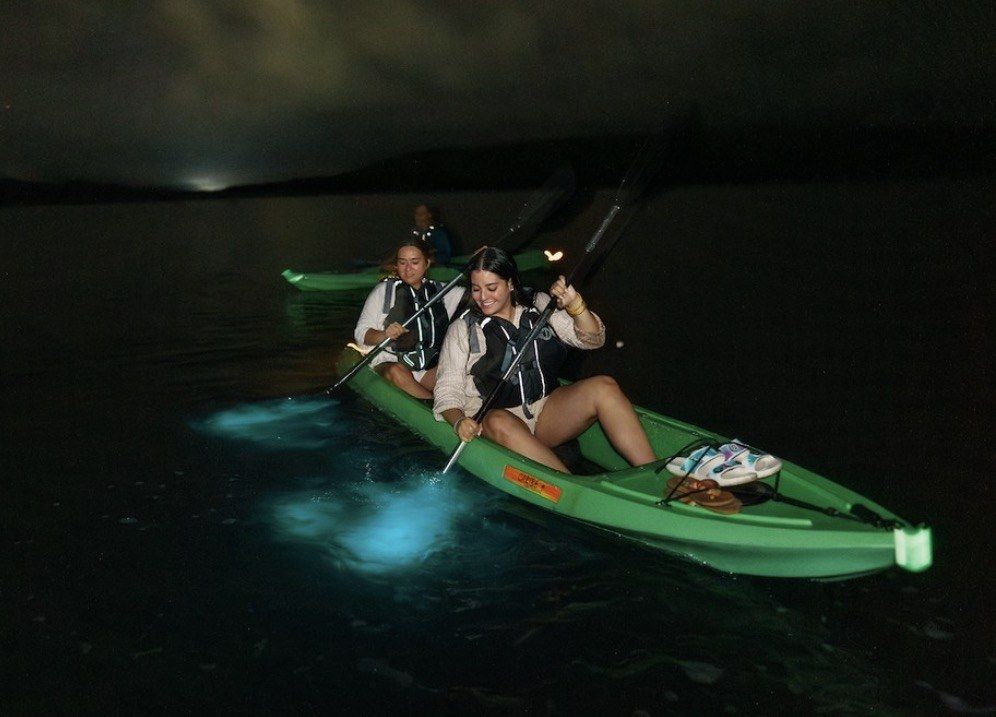
- Every paddle stroke leaves a bright swirl behind the blade, and the drops running off it on the recovery light up one by one before they hit the surface.
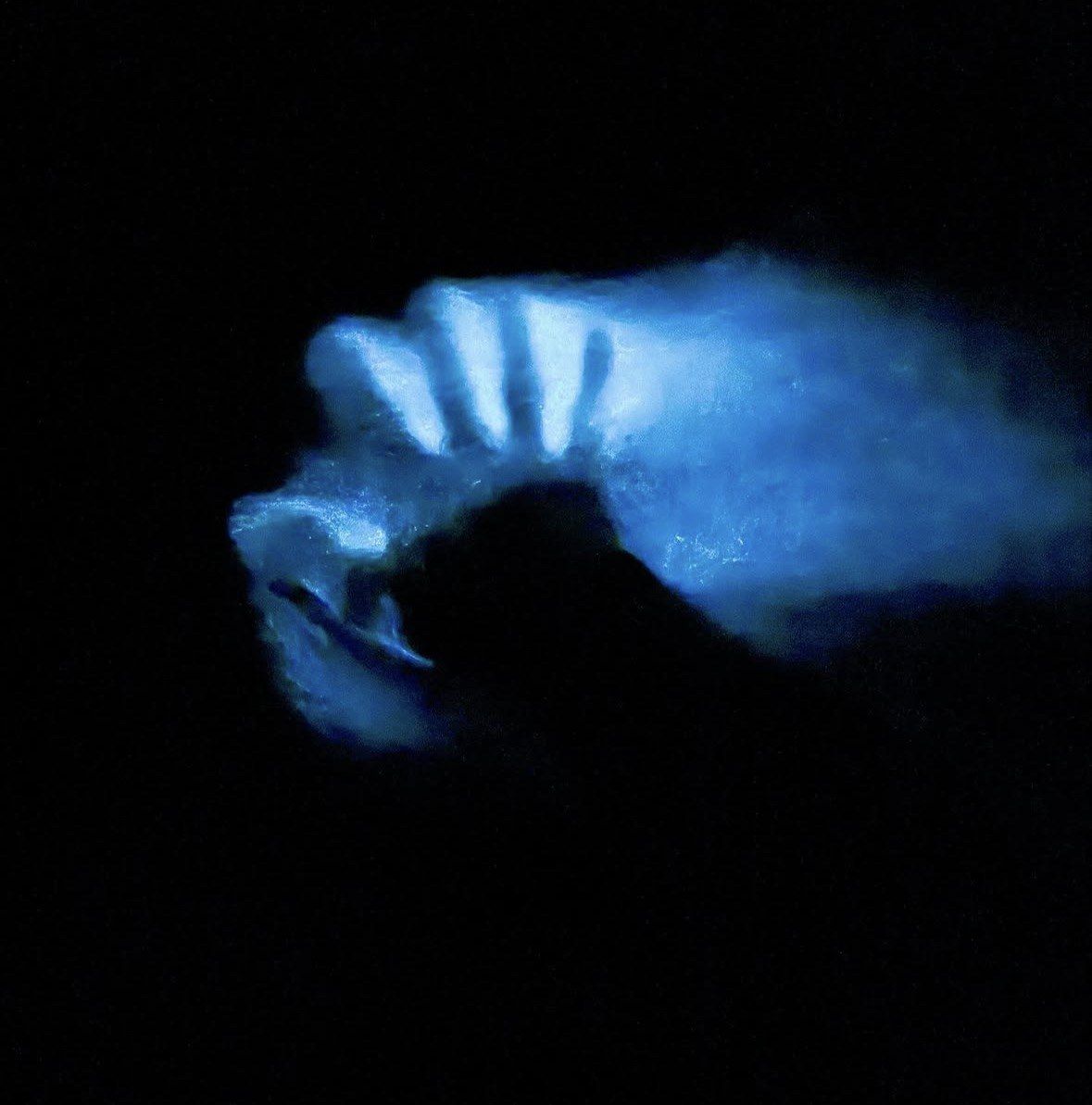
- A hand or forearm dragged alongside pulls a glowing trail that fades a second or two after you stop.
- Fish and shrimp bolting away from the hull show up as fast streaks several feet down.
- The wake behind a boat lights along both edges, which is why the pontoon trip works even though nobody on board is paddling.
- Water poured from a cupped hand glows as it falls, and that is the closest you get to holding it: swimming is prohibited by DRNA, and operators are not allowed to let guests into the water.
Seated on a pontoon, 40 minutes
If paddling is out for anyone in your group, the wake of a 24-foot pontoon sets off the same flashes along both sides of the boat: from $85, 40 minutes, pickup across from the Sun Bay entrance, with a $3.00 cash fee for the Department of Natural Resources charged separately.
★ 4.4/5 · 262 reviews
Clear-bottom hulls, and whether they change anything
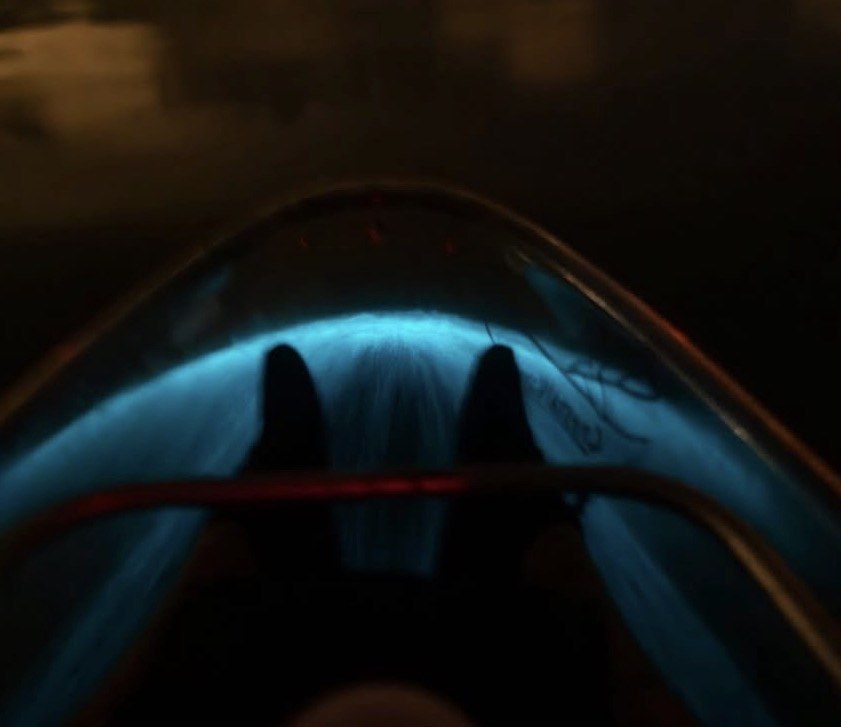
A transparent hull does not create more light. It changes your viewing angle. Instead of leaning over the side to watch a patch of disturbed water, you look straight down through the floor at the water the kayak is displacing as it moves, which is where the strongest reaction is happening anyway. Several licensed operators on the bay run clear-bottom tandems or fully transparent boats for that reason, and published rates among other licensed operators sit at $70 for a 1.5-hour clear-bottom kayak and $75 for a 2-hour one.
If you want the clear hull, take the 1.5-hour kayak tour on this site, from $60, rated 4.8 from 491 reviews, with clear kayaks, paddles, life jackets and transport from the meeting point to the bay and back. The hull matters least on a calm night with a boat full of people, because the cells need movement and a stationary kayak sits over dark water.
Boats and kayaks both enter the bay only with a licensed concessionaire, under a conservation certification program coordinated with DRNA. A cap of ten people per group and a run of about an hour and a half set how much water gets stirred, and for how long.
Who measures the organisms, and what the rules protect
DRNA holds the reserve and co-manages it with the Vieques Conservation & Historical Trust, which has worked on the island for 40 years. Counting the cells week by week sits with the trust, alongside its erosion control and water-quality monitoring, on a lagoon it says more than 200,000 visitors reach each year.
Sediment washing off the access road counts as a direct threat to the Class SA water. EPA money funded a two-year project worth $74,999, bringing together the trust, DRNA and the USGS to keep road runoff out of the lagoon.
The rules on your tour follow from the biology. DEET-based repellent is banned because it kills the organisms that produce the light, so bring a DEET-free spray instead; sunscreen and lotion use is restricted; and swimming is prohibited, partly to limit what repellents and sunscreens put into the water. The kit list that follows is short: a towel, a DEET-free spray, and sandals, flip flops or water shoes. You will still want something against bites, and the CDC's island-wide picture explains why: dengue transmission in Puerto Rico is frequent, carried mainly by Aedes aegypti, peaking seasonally from July through November, with major outbreaks every 3 to 7 years.
The readings right now, and how to book around them
The weekly counts tell the current story plainly. By the last week of September 2026 the light had dropped to effectively zero, the end point of a slide that started in July and was reported on 9 October 2026. In this lagoon's record for the century, that makes three blackouts. Waldemar Quiles, the DRNA secretary, said the agency's technical staff had been evaluating the falling readings since July and called the question one of great importance to the agency.
There is precedent on both sides. Counts recovered after the 2014 episode, and the cells went missing for roughly seven months following Hurricane Maria in 2017 before the lagoon lit again. Tourism on the island has carried on through this one: the mayor said visitors keep arriving even without the glow and expected improvement by November. The operators' framing is that the bay is visible year-round with conditions that vary, because the ecosystem is dynamic.
What that means for your money: if the light is the entire reason for the trip, do not lock in travel you cannot get back, and check where the weekly counts stand before you commit. Ferry tickets are explicitly non-refundable. Cancelling a tour listed here at least 24 hours before the scheduled departure time gets the full amount back, and a night the operator judges extreme or dangerous is cancelled and refunded. The moon sets the other half of the calendar: no company is permitted to run on the night before, the night of or the night after a full moon, and the least-lit nights coming up cluster around 9 November 2026, 8 December 2026 and 7 January 2027.
Questions people ask
Can I take a photo of the glowing water?
Plan to watch it rather than record it. The flashes last a fraction of a second and happen only where the water is being moved, which is the opposite of what a phone camera handles well. Treat any usable image as luck, and keep screens off so your night vision holds.
Why is DEET banned on the tours?
DEET kills the dinoflagellates that produce the light, so operators do not allow it on the water and ask visitors to bring a DEET-free bug spray instead. Sunscreen and lotion use is restricted for the same reason. Swimming is prohibited by DRNA, partly to limit what repellents and sunscreens add to the lagoon.
Can I put my hands in the water?
Hands and forearms in the water are how most people trigger the brightest trails they will see all night, and guides demonstrate it. Getting into the water is a different matter: swimming is prohibited by DRNA, and operators are not permitted to let guests enter the bay. Dress on the assumption that your sleeves and your feet come back wet.
Is the glow strong enough to see without any equipment?
When counts are high, yes, with the naked eye and no light source at all. The limiting factor is ambient light rather than equipment, which is why no company may run on the three nights around each full moon and why operators point people towards the new moon. Adjusting to the dark takes several minutes once you are on the water.
Does the whole bay light up at once?
No. The organisms respond to mechanical disturbance, so light appears where paddles, hulls, hands and fish move the water, then fades within a second or two. A still, untouched surface stays dark even on the brightest nights the bay has recorded.
Read also