In shortYes. The lagoon is ringed by mangroves and trips run after dark, so expect biting insects, worst on windless evenings. The spray you bring has to be DEET-free, since DEET kills the dinoflagellates behind the glow, and sunscreen or lotion should be kept to a minimum. The name is a separate question: official records call the bay Puerto Mosquito, and the pirate ship explanation is local legend.
DEET-freeOnly repellent permitted
1980National Natural Landmark
LegendStatus of pirate ship story
from $652-hour kayak trip
Does Mosquito Bay have mosquitoes?
Yes, in the way that matters for your evening. Mangroves line the shore, the water inside has almost no current, and trips go out between 6:00 and 9:00 pm, which is exactly when biting insects are active. Nobody publishes an insect count for this lagoon, so treat any website that names a worst month as guessing.
Still air is the thing to watch. On an evening with a breeze coming across the water you may barely notice anything; on a heavy, windless one the launch area and the first few minutes of paddling are where people get bitten. Once you are out on the open water of the bay it usually eases off.
Dengue is the reason a spray belongs in your bag at all, and the figures are island-wide rather than specific to Puerto Mosquito. CDC records frequent transmission in Puerto Rico, mainly through Aedes aegypti, with case numbers highest from July through November, larger outbreaks at intervals of 3 to 7 years, and a steep rise in May during the 2024 outbreak as the rains set in.
What you may put on your skin, and what is banned
DEET is out. Operators will not allow it on bio bay trips because it kills the dinoflagellate that produces the light, so the spray you brought from home is probably the wrong one. Buy or pack a DEET-free product before you travel, since the gear shop on the island sits in Isabel Segunda and shuts in the afternoon.
Skin products in general are treated as contamination here. DRNA prohibits swimming in the bay partly for that reason, and operators cannot let guests into the water, so there is no cooling off to wash anything away. Keep sunscreen and lotion to a minimum on the day of your tour.
| Item | On a bio bay tour |
|---|
| DEET-based repellent | Not allowed on board; fatal to the organisms behind the glow |
|---|
| DEET-free bug spray | Bring it, and apply before you arrive |
|---|
| Sunscreen and lotion | Use restricted |
|---|
| Swimming | Prohibited by DRNA; operators cannot let guests enter the water |
|---|
| Towel, sandals, flip flops or water shoes | Listed as recommended kit by the operator |
|---|
The classic two-hour paddle from Esperanza
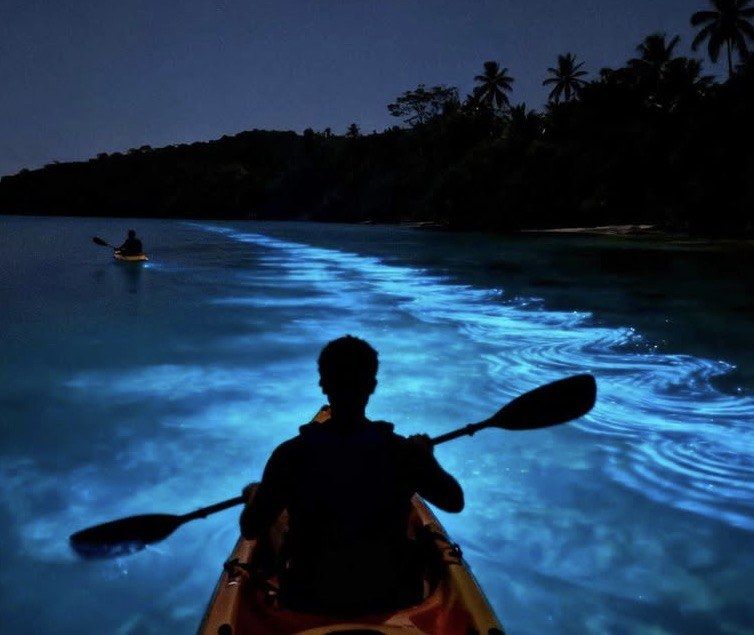
Spray DEET-free repellent at your lodging, walk to the Calle Flamboyan meeting point, and this 2-hour trip from $65 covers the ride to the Bio Bay entrance, the paddle, a life jacket and a guide, rated 4.5 from 1243 reviews.
★ 4.5/5 · 1,243 reviews
Why Mosquito Bay is called that
Two different things get mixed up here. The name itself is documented: federal and territorial agencies use Puerto Mosquito, which is why the register kept by the U.S. Fish and Wildlife Service carries it as the Puerto Mosquito National Natural Landmark, a status dating from the 1980 proclamation, with the site held in territorial ownership by Puerto Rico's Department of Natural and Environmental Resources. Mosquito Bay is the English form of that Spanish name.
The explanation for where the word came from is a different matter. Tradition links it to the Mosquito, a ship belonging to the Puerto Rican pirate Roberto Cofresi, and that account is handed down as legend rather than documented history. No official or primary source we could open sets out the origin of the name, so anyone giving you a date or a founding incident is filling a gap.
The name carries no implication about the water itself. An insect in the title has not stopped EPA calling this the only pristine bioluminescent bay in Puerto Rico, nor DRNA placing its water in Class SA, the agency's top category for ecological and recreational value. The federal landmark citation goes further in its wording: the best example of a bioluminescent bay in the United States.
- Attested: the official name Puerto Mosquito, in federal and territorial records, and the 1980 landmark proclamation.
- Local lore: the pirate ship Mosquito, repeated widely and presented as legend.
- Not documented anywhere we could verify: when or why the word entered use.
Dressing for a mangrove shoreline after dark
Cover skin rather than relying on spray alone. A long-sleeved layer you do not mind soaking, plus trousers or anything that reaches past the ankle, deals with most of it, because ankles and the backs of hands are where bites land while you are sitting in a kayak. Footwear should be sandals, flip flops or water shoes, as the operator recommends.
Put the DEET-free spray on at your lodging before you head out. That way it has dried before you handle a paddle, and it keeps repellent off the boats and out of the water. A towel is worth packing; anything bigger stays behind, since a group of up to ten people on a paddle of roughly an hour and a half leaves nowhere to stow a bag.
Pick a night and book it
Insects come down to what you pack. The moon and the present state of the water are the two things that actually constrain your date. Three nights each month are closed to every company, the one before a full moon, the full moon itself and the one after, while the darkest skies arrive with the new moons of 9 November 2026, 8 December 2026 and 7 January 2027. Ask the operator to confirm the closed dates for your week, because the sources published for late 2026 give conflicting full moons.
Be honest with yourself about the glow before you commit to non-refundable travel. As of 9 October 2026 the light was gone: readings through the final week of September 2026 came out at effectively nothing, the bottom of a decline running since July 2026, counted as the third blackout at the bay this century, with DRNA technical staff still going over the numbers. Darkness has not been permanent before. The organisms came back after the 2014 episode, and after Hurricane Maria in 2017 they were missing for about seven months before the bay glowed again.
Hold a tour you can still drop. Cancel any of the trips listed here at least 24 hours ahead of the scheduled departure time and the whole amount comes back, and a night the operator judges extreme or dangerous is called off with a refund. Entry is only with a licensed concessionaire, so there is no version of this where you walk down to the mangroves on your own.
Questions people ask
Can I use my normal DEET spray if I keep my hands out of the water?
No. Operators do not allow DEET-based repellent on bio bay trips at all, because it kills the dinoflagellates that produce the light. Hands, paddles and clothing all touch the water in a kayak, and drips off your skin end up in a lagoon with very little flushing. Bring a DEET-free product instead.
Which biting insects are actually there, and when are they worst?
No official monitoring source documents which species are present at the bay or how they vary through the year, so we will not pretend to give you a calendar. What is confirmed is the setting, mangrove shoreline and still water after dark, and the requirement to carry DEET-free spray. CDC seasonality for dengue in Puerto Rico, July through November, is island-wide rather than a measurement at this lagoon.
Is Puerto Mosquito the same place as Mosquito Bay?
Yes, one is the Spanish name and the other the English form of it. Federal and territorial paperwork uses Puerto Mosquito, including the Puerto Mosquito National Natural Landmark designation held by the U.S. Fish and Wildlife Service. Tour operators and most English-language listings call it Mosquito Bay.
Does the pirate story about the name have any evidence behind it?
What exists is tradition: the word is said to come from the Mosquito, a vessel sailed by the Puerto Rican pirate Roberto Cofresi. It is presented as legend rather than documented history, and no official or primary source we could open sets out an origin for the name. Treat specific dates attached to the story with suspicion.
Does the name mean the water is dirty or unhealthy?
No. In EPA's wording this is Puerto Rico's only pristine bioluminescent bay, and DRNA keeps its water in Class SA, the top category for ecological and recreational value. The swimming ban exists partly to keep repellent and sunscreen residue out of the lagoon, which is also why no operator may let you into the water.
Read also