In shortNo. Swimming in Mosquito Bay is prohibited by Puerto Rico's Department of Natural and Environmental Resources, and the operators licensed to work on the bay are not allowed to let guests enter the water. The ban keeps sunscreen, lotion and repellent out of a small enclosed lagoon. You see the glow from a kayak or a seated pontoon, with a certified concessionaire.
ProhibitedSwimming in the bay
Class SADRNA water classification
700,000Cells per gallon, 2006
from $601.5-hour clear-kayak tour
Can you swim in Mosquito Bay?
Swimming is banned. Puerto Rico's Department of Natural and Environmental Resources holds Puerto Mosquito as a natural reserve and prohibits swimming in it, and the operators who work the bay are not allowed to let guests get in. Guides and operators here are covered by a conservation certification program coordinated with DRNA, so the person running your trip has a licence on the line.
The licence is also why nobody turns up at the water unaccompanied. Only a concessionaire may take you onto the bay, kayaks being the craft most of them use, and jet ski outings for tourists are ruled out as firmly as swimming is. There is no visitor centre and no ticket office at the water, so the only lawful way in is with a concessionaire who has a boat or a kayak on the launch.
EPA calls this the only pristine bioluminescent bay in Puerto Rico and records DRNA's classification of the water as Class SA, the highest ecological and recreational value category. A lagoon in that category is managed tightly, and the swimming ban is the most visible part of it.
Why can't you swim in Mosquito Bay
The reason DRNA gives is contamination from repellents and sunscreens. Mosquito Bay is small and nearly closed off, so whatever is on a swimmer's skin stays in the water rather than washing out to sea, and the trust that co-manages the reserve counts more than 200,000 visitors reaching the bay each year. Multiply one swim by that number and the arithmetic is obvious.
Sediment is the second problem. Bodies in shallow water stir the bottom, and the bay already has a runoff issue from the access road above it: EPA paid for a two-year project worth $74,999, run with the trust, DRNA and the USGS, specifically to keep road sediment out of the lagoon. Clouded water also makes the glow harder to see for everyone else in the group.
The third reason is how narrow the biology is. Everything the ban protects rests on one species, Pyrodinium bahamense var. bahamense, whose numbers the co-managing trust's biologist tallies every week. Guinness World Records entered the bay in 2006 as the brightest of its kind on a figure of up to 700,000 cells per gallon, and that population can collapse: as of 9 October 2026 readings had fallen to effectively zero in the last week of September 2026, after a gradual slide from July 2026, the third blackout recorded this century. The agency's own secretary, Waldemar Quiles, described the fall in readings as a matter of great importance to DRNA and said technical staff had been working on it since July.
Blackouts here have ended in recovery before, after the 2014 episode and after Hurricane Maria in 2017, when the organisms were absent for roughly seven months. DEET-based repellent is banned on tours for the same reason the swimming ban exists: it kills the dinoflagellates. Since no reading predicts what a given night will look like, book something you can drop, and the tours on this site refund in full if you cancel at least 24 hours before the scheduled departure time.
What the guides enforce once you are on the water
Expect the briefing before you launch to cover all of this, and expect the guide to mean it. Trips are small and short by design: groups do not exceed ten people and a tour lasts about an hour and a half, which leaves nowhere to hide a swim and no room for luggage in the boat.
- One licensed operator's packing list comes down to things you can get wet: a towel, DEET-free bug spray, and sandals, flip flops or water shoes.
- Wear clothes and shoes you do not mind soaking; paddling gets you wet without anyone getting in.
- Extreme or dangerous conditions are the operator's call, and a trip cancelled on those grounds is refunded.
| Rule on Mosquito Bay | Where it comes from |
|---|
| Guests stay in the kayak or on the pontoon; entering the water is not allowed | DRNA, to limit contamination from repellents and sunscreens |
|---|
| No DEET-based insect repellent; bring DEET-free spray instead | Operators, because DEET is lethal to the light-producing dinoflagellates |
|---|
| Sunscreen and lotion use is restricted | Operator instructions for bio bay tours |
|---|
| No jet ski tourist trips inside the bay; kayaking with licensed concessionaires is the permitted activity | Reserve rules as reported by local press |
|---|
| No access on your own; every visit is led by a licensed concessionaire | Reserve rules; most concessionaires run kayaks |
|---|
| Three nights a lunar month are closed to every company: the full moon, plus the night either side | Operators attribute the closure to DRNA |
|---|
Seeing the glow from a kayak or through a clear hull
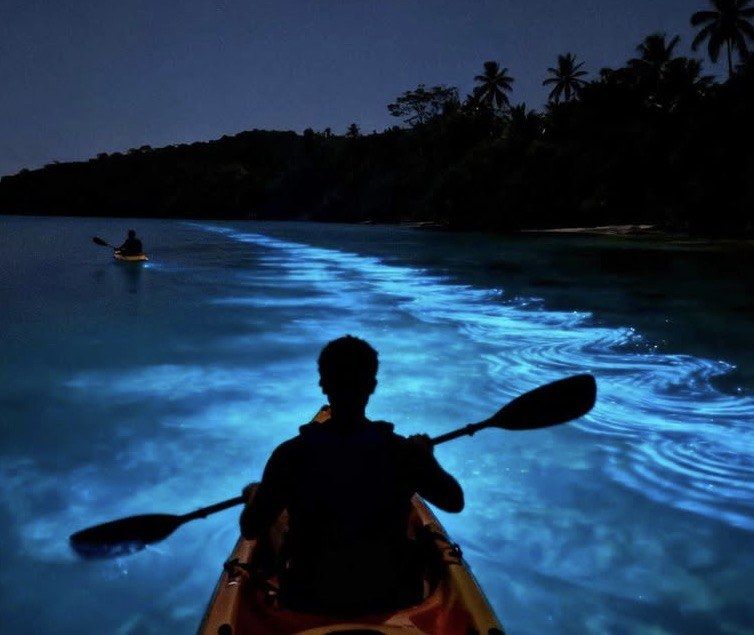
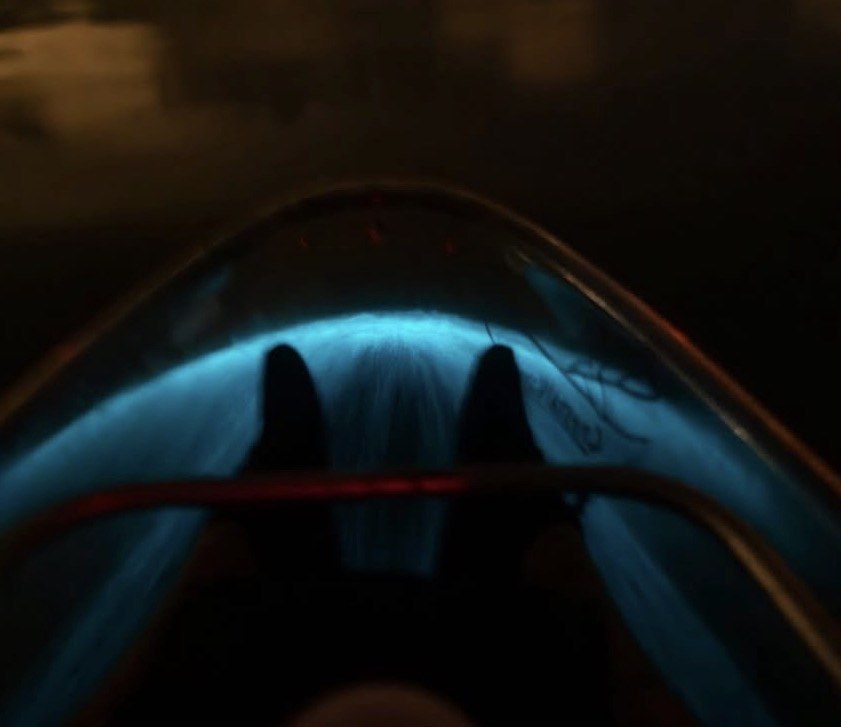
Paddling is what sets the water off. Every stroke agitates the surface right beside you and the cells flash in the wake, which is why kayaking is both the permitted activity and the better show. Several licensed operators on the bay run clear-bottom tandems or fully transparent kayaks so the light comes up through the floor between your knees; published rates among other licensed operators include $70 for a 1.5-hour clear-bottom kayak and $75 for a two-hour one, and one operator based on Calle Flamboyan in Esperanza uses fully transparent boats.
The clear-hull trip listed on this site runs 1.5 hours from $60 and is the highest-rated option here at 4.8 from 491 reviews. Clear kayaks, paddles, life jackets, a guide who briefs in Spanish and English, and the drive from the meeting point out to the bay and back are all in the price; the meeting point is across the street from the Sun Bay beach entrance, always 25 minutes before your tour time, so a 7:00 pm tour means 6:35 pm.
Anyone in the party who cannot paddle, cannot get wet, or is uneasy on water after dark should take the seated option instead. The Bioluminescent Boat Tour in Mosquito Bay is 40 minutes from $85, rated 4.4 from 262 reviews, with pickup in front of the Sun Bay entrance in a black Ford 350 van, an air-conditioned vehicle to the launch, emergency life jackets and a 24-foot pontoon. The Department of Natural Resources fee of $3.00 is collected separately in cash, and the price covers neither ferry tickets, nor the one night of accommodation the tour requires, nor a ride from where you are staying on Vieques.
The clear-hull way to see it without swimming
Clear kayaks put the light directly under you, which is the closest you are allowed to get to the water: 1.5 hours from $60, rated 4.8 from 491 reviews, with transport from the Sun Bay meeting point to the bay and back included.
★ 4.8/5 · 491 reviews
What to bring when you cannot get in
Skip sunscreen and lotion on tour day. You are going out after dark, you will be in the boat the whole time, and both are restricted by the operators for the same reason the swimming ban exists. Bring DEET-free repellent or none at all, and leave the DEET at home rather than in your bag.
Bites deserve planning, and the honest frame is the CDC's island-wide data rather than anything measured at the bay: dengue circulates frequently in Puerto Rico, Aedes aegypti does most of the transmitting, cases peak from July through November, major outbreaks come round every 3 to 7 years, and in the 2024 outbreak the count rose steeply in May as the wet season started. Cover up and use a DEET-free spray.
Pack light. A towel, water shoes or flip flops, and clothes you can soak cover it, and a big bag is better left at your lodging. Plan to look rather than photograph, because the cells flash for a moment at a time.
The calendar matters as much as the kit. Three nights around every full moon are closed to all companies, the one before, the full moon itself and the one after, while the least moonlight falls near a new moon; the next ones are 9 November 2026, 8 December 2026 and 7 January 2027. Sources do not agree on the late-2026 full-moon dates, so get the closed nights for your own week confirmed by the operator before you pay.
Where you can swim on Vieques instead
Do your swimming in daylight, on the south shore, and keep the lagoon for after dark. Balneario Sun Bay sits off Route 997 in the Esperanza area and is staffed Wednesday to Sunday and on public holidays, 8:30 a.m. to 5:00 p.m., while the beach itself stays open 24 hours. The charge is attached to the vehicle you arrive in: $2 motorcycles, $3 cars, $4 mini-vans, $5 buses. On site you have lifeguards, toilets, parking, a cafeteria, picnic shelters and a camping area.
The Esperanza malecón beach immediately west of Sun Bay is listed with a swimming area, snorkelling and diving, lifeguards and accessible provision for visitors with disabilities, which puts it within walking distance of the Calle Flamboyán lodgings. On the north coast, Rompeolas (Mosquito Pier) is listed with swimming, snorkelling and diving and surfing areas, and with abundant marine life, corals and reefs.
One practical sequence for a beach day followed by a tour: swim and sunbathe early, then rinse off and change at your lodging before you head to the meeting point, so the sunscreen you used at noon is not going into the bay at nine.
Questions people ask
Is the Mosquito Bay swimming ban actually enforced?
Yes. It is DRNA, Puerto Rico's Department of Natural and Environmental Resources, that prohibits swimming, and the concessionaires carry the duty of keeping guests out of the water. Guides and operators on the bay are covered by a conservation certification program coordinated with the agency, so asking your guide to make an exception puts their concession at risk.
Can I walk down to the bay and swim on my own?
No. Arriving alone is not an option here: a licensed concessionaire has to lead the visit, and there is nowhere at the bay to buy a ticket or ask at a desk. Parts of the neighbouring Vieques National Wildlife Refuge are closed to the public and may not be entered by land or by sea at any time.
Can I wear sunscreen if I put it on in the morning?
Sunscreen and lotion use is restricted on these tours, so the simplest approach is to skip both on the day you are going out. If you have spent the day on a beach, shower and change before you reach the meeting point. Repellent follows the same logic: DEET is barred from the tours because it kills the organisms that produce the light, so carry a DEET-free spray.
Does anyone get into the water on the boat tour?
No. The Bioluminescent Boat Tour in Mosquito Bay is 40 minutes on a 24-foot pontoon, seated the whole way, from $85, with pickup in front of the Sun Bay entrance and a $3.00 cash fee for the Department of Natural Resources charged separately. The same DRNA rule applies on a boat as in a kayak.
Does the refuge trail above the bay show the bioluminescence?
The U.S. Fish and Wildlife Service maintains a 2.5-mile moderate trail from the refuge entrance parking lot to a platform above the bay, and that is a daytime walk for orientation and views. Seeing the light means being on the water after dark with a licensed concessionaire, and the refuge gates are shut by then anyway: 7:00 am to 7:30 pm from March 1 to August 31, and 7:00 am to 6:30 pm from September 1 to February 28.
Read also